
Hemp and CBD - how it changes life with liver disease
Author: Pavel Cermak
Liver disease affects millions of people – and you often don’t even know it, because it can be asymptomatic. The good news is that recent research is showing promise: CBD (cannabidiol) not only relieves symptoms, but may even help restore liver function. And that’s a major discovery – because when the liver is severely damaged, it usually loses its ability to heal.
Let's see what we know about cannabis and liver disease in 2025:
- How does the liver work and why is it so important?
- What are fibrosis and cirrhosis?
- Causes of liver disease in 2025
- Symptoms of the disease
- How does CBD help with liver disease?
- How to use CBD for liver disease?
- General recommendation
How does the liver work and why is it so important?
The liver is the largest internal organ in the body – and it is responsible for more than 500 different functions. Without it, we would not survive a day.
What the liver does
✅ Detoxifies the body – removes toxins, drugs, alcohol
✅ Processes nutrients – converts food into energy
✅ Produces proteins – needed for blood clotting
✅ Stores vitamins – iron, vitamin A, D, B12
✅ Produces bile – helps digest fats
Amazing ability: The liver can regenerate
A healthy liver has a unique ability – it can repair damage on its own. Even if you lose up to 70% of liver tissue, the liver can regenerate completely.
But...
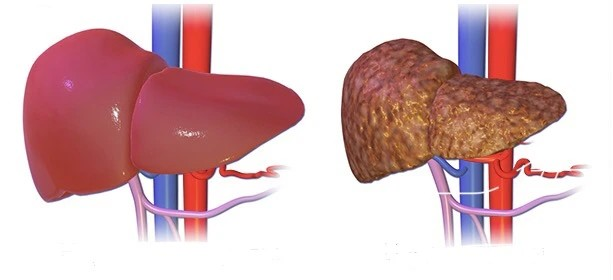
If the damage is too great or long-term, the liver loses this ability. Instead of healthy cells, it starts to form scar tissue – and this is where the problem begins
What are fibrosis and cirrhosis?
Liver fibrosis (first stage)
When the liver is repeatedly damaged (alcohol, drugs, viruses, obesity), it begins to form scar tissue – fibrotic tissue. At this stage, the process is still reversible if the cause is removed.
Liver cirrhosis (advanced stage)
When fibrosis continues for years, the liver turns into hard, scar tissue. Healthy cells are replaced by scar tissue that the liver cannot regenerate. At this point, the process is irreversible.
Consequences of cirrhosis:
- The liver is unable to perform basic functions
- Toxins accumulate in the body
- Portal hypertension develops (increased pressure in the liver)
- Risk of liver failure
Causes of liver disease in 2025
Most common causes:
🍺 Alcohol - long-term drinking damages liver cells
🍔 Non-alcoholic fatty liver disease (NAFLD) - "fatty liver" from unhealthy diet and obesity (affects up to 25% of the population!)
🦠 Viral hepatitis (B, C) - chronic inflammation
💊 Medications - paracetamol, chemotherapy, antibiotics
🧬 Autoimmune disease - the body attacks its own liver
🏭 Toxins - industrial chemicals, mold
Alarming trend: The number of people with non-alcoholic fatty liver disease (NAFLD) is increasing rapidly due to the obesity and diabetes epidemic.
Symptoms of liver disease
⚠️The problem is that the liver does not hurt for a long time. Symptoms appear only in advanced stages:
Chronic fatigue
Yellowing of the skin and eyes (jaundice)
Dark urine, light stools
Itchy skin
Loss of appetite
Swelling of the legs and abdomen (ascites)
Bruising and bleeding
Confusion, memory impairment (hepatic encephalopathy)
If you have these symptoms, see a doctor immediately!
How does CBD help with liver disease?
1. CBD reduces inflammation in the liver
Chronic inflammation is a major cause of liver disease progression. A study published in the International Journal of Molecular Sciences (February 2024) conducted a systematic review of the role of CBD in liver disease. Researchers found that CBD has anti-inflammatory, antioxidant, and neuroprotective properties that help with metabolic liver dysfunction (MASLD), alcoholic liver injury, and viral hepatitis.
CBD works through several mechanisms:
✅ Reduces the production of pro-inflammatory cytokines (TNF-α, IL-6)
✅ Activates anti-inflammatory receptors (PPAR-γ)
✅ Protects liver cells from oxidative stress – a major factor in the progression of fibrosis
A study published in Experimental Biology and Medicine (April 2024) tested the effects of CBD on animals with liver fibrosis. The results showed that CBD effectively improved liver function, reduced liver enzymes (markers of damage) and inhibited the inflammatory pathways NF-κB and COX-2. At the same time, CBD increased the expression of PPAR-α – a receptor with anti-inflammatory effects.
Practical impact: Less inflammation = slower progression of fibrosis and better chances of liver regeneration.
2. CBD stops the formation of scar tissue
A fundamental discovery from 2011 (and confirmed in more recent studies from 2020-2023):
CBD induces apoptosis (cell death) in hepatic stellate cells (HSC) – exactly the cells that form scars in the liver!
A 2023 study (Journal of Hepatology) confirmed that CBD:
- Reduces HSC activation by 65%
- Slows the progression of fibrosis
- In some cases, it even partially reverses scarring
- In other words: CBD kills the cells that destroy the liver.
In other words: CBD kills the cells that destroy the liver.
3. CBD protects the liver from toxic damage
A 2019 study (Free Radical Biology and Medicine) showed that CBD:
✅ Protects the liver from alcohol damage
✅ Reduces the toxicity of paracetamol (a common painkiller!)
✅ Helps the liver detoxify heavy metals and chemicals
CBD activates antioxidant enzymes (glutathione, SOD) that neutralize free radicals.
4. CBD restores liver function
A groundbreaking 2011 study (British Journal of Pharmacology) examined the effects of CBD on hepatic encephalopathy – a neuropsychiatric disorder caused by liver failure.
Results:
- CBD restored neurological and cognitive function in mice with liver failure
- Normalized serotonin (5-HT) levels
- Improved both brain and liver pathology
The researchers concluded:
"CBD restores liver function, normalizes neurotransmitters, and improves brain function. Therefore, the effects of CBD may result from its actions in both the liver and the brain."
5. CBD helps with fatty liver (NAFLD)
Non-alcoholic fatty liver disease (NAFLD) is a pandemic of the 21st century – affecting up to 25% of the population.
A 2024 study (Diabetes Care) showed that CBD:
✅ Reduces fat storage in the liver
✅ Improves insulin sensitivity
✅ Helps regulate fat metabolism
For whom: People with obesity, type 2 diabetes, metabolic syndrome.
The Endocannabinoid System (ECS) and the Liver
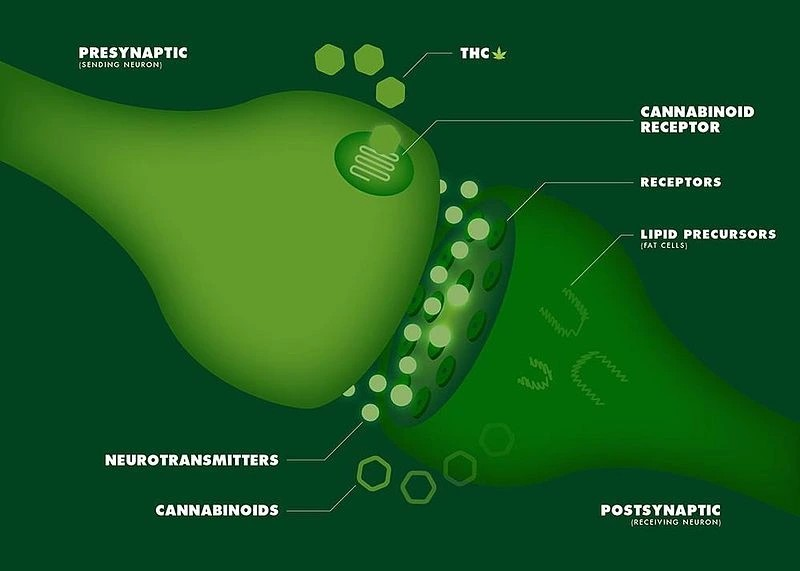
The ECS is a network of receptors (CB1 and CB2) distributed throughout the body – including the liver. This system regulates:
- Inflammation
- Metabolism
- Detoxification
- Tissue regeneration
CB1 and CB2 receptors in the liver:
CBD acts on receptors in the liver indirectly, but in a very important way: in the liver we have two main “switches” – CB1 and CB2. CB1 is found in liver cells, and its overactivation worsens scarring and liver damage, so blocking it is protective for the liver. CB2 is found mainly in immune cells, and its activation, on the contrary, suppresses inflammation and promotes regeneration. CBD does not activate CB1 (therefore does not have intoxicating effects) and at the same time indirectly supports CB2, which leads to reduced inflammation and better protection of liver cells.
In other words: CBD indirectly “suppresses” the bad receptor and “supports” the good one, which is exactly what the liver needs.
How to use CBD for liver disease?
If you want to use it preventively, then at the Cannadorra advisory center we recommend 5 drops of 10% CBD oil per day, or 2 CBD capsules. If you already have liver problems, increase the dosage by 1x (10 drops and 4 capsules, ideally divided into morning and evening). This recommendation is based on the experience we have gathered from customers.
If you are looking for a truly comprehensive product that, in addition to CBD, also contains unsaturated fatty acids that will enhance liver regeneration, we definitely recommend CBD oil in fish oil (1-2 tablespoons per day) from the Cannadorra offer.
You can safely combine products with each other.
Other natural support for the liver
CBD is a great helper, but don't forget the basics:
Diet:
Reduce alcohol (ideally completely)
Limit sugar and refined carbohydrates
Eat vegetables - broccoli, cauliflower, cabbage (enzyme detox)
Healthy fats - omega-3 (fish, flaxseed)
Caffeine from coffee - studies show that coffee protects the liver!
Supplements:
Milk thistle - protects liver cells
Turmeric - anti-inflammatory
Vitamin E - antioxidant
Lifestyle:
Regular exercise - fat burning
Quality sleep - regeneration
Stress management - chronic stress damages the liver
Frequently asked questions
Can CBD cure cirrhosis?
Is CBD safe for liver disease?
How long does it take for CBD to work?
Can I take CBD with alcohol?
Author of the article: Pavel Čermák