
FAAH enzyme - key to managing stress, pain and fatigue
Article Author: Lucie Garabášová
Do you know that feeling when, after a long run or a meditation session, you suddenly feel amazing—calm, content, and free from pain? I personally experience it after horseback riding :-). Behind this state is, among other things, a small molecule called anandamide, often referred to as the “bliss molecule.” And how long this feeling lasts is determined by an enzyme you may never have heard of: FAAH.
📋 Quick Summary
- FAAH is an enzyme that breaks down anandamide (the “bliss molecule”) and influences mood, stress resilience, sleep quality, and pain perception.
- CBD, PEA, and beta-caryophyllene may naturally support the endocannabinoid system during periods of stress, recovery, menopause, or chronic pain.
- Consistency and long-term use are key—the research into these compounds is still ongoing, and their effects develop gradually over time.
What Is Anandamide and Why Should We Know About It?
Anandamide is a compound that the body produces naturally. It belongs to a group of substances known as endocannabinoids—cannabinoids that are naturally present in the body. Its name comes from the Sanskrit word ananda, meaning bliss, and this name is no coincidence. Anandamide influences mood, sleep, pain perception, the ability to relax, and emotional stability. The longer it remains active in the body, the more we experience its beneficial effects.
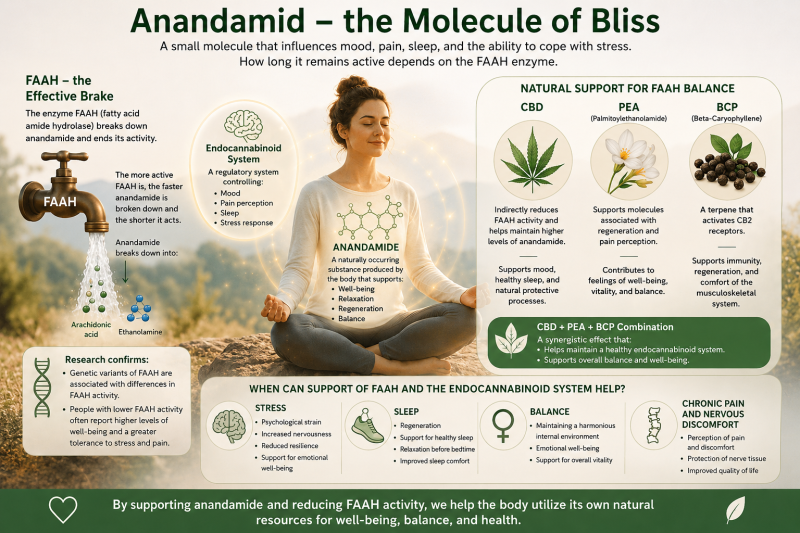
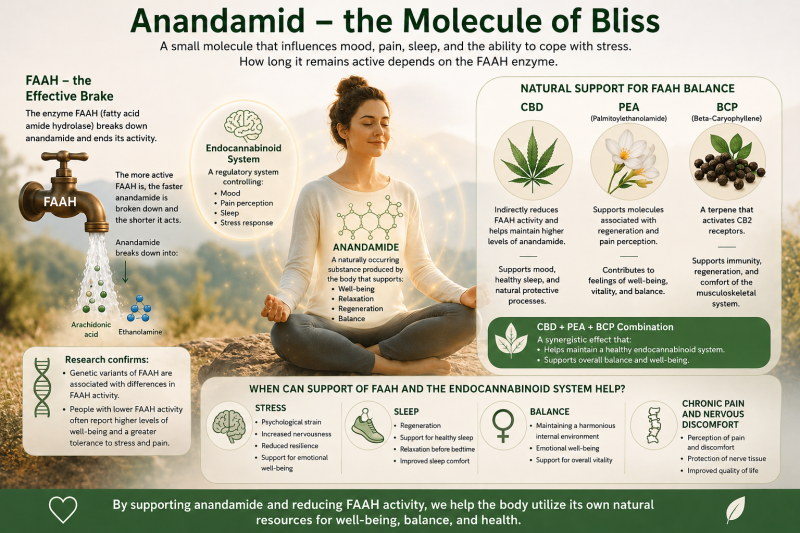
However, the body also has its own “off switch.” It is called FAAH—fatty acid amide hydrolase. This is an enzyme whose primary role is to break down anandamide and terminate its effects.
FAAH: The Brake on Good Mood
Imagine FAAH as a faucet controlling the flow of water. The more open it is, the faster anandamide disappears from the body and the shorter its effects last. Conversely, when FAAH activity is lower, anandamide remains active for longer, helping the body maintain a more natural balance.
Biochemically, the breakdown of anandamide involves its conversion into arachidonic acid and ethanolamine. This process occurs primarily in the brain, central nervous system, liver, and immune cells—precisely the areas where the endocannabinoid system plays its most important role.
Interestingly, some people naturally have lower FAAH activity due to a genetic variation known as FAAH C385A. These individuals tend to cope with stress more effectively, perceive pain less intensely, and are generally more psychologically resilient. It is not a matter of luck or willpower—it is biochemistry.
🔍 Click to enlarge
The Endocannabinoid System: The Body’s Control Center
To better understand the role of FAAH, it helps to view the endocannabinoid system as a whole. It is one of the most extensive regulatory systems in the human body and was only discovered in the 1990s—ironically thanks to research on cannabis cannabinoids.
You can read the full article about the endocannabinoid system HERE.
How CBD, PEA, and BCP Naturally Support FAAH Balance
Modern cannabinoid research suggests that certain natural compounds can gently influence FAAH activity, helping anandamide remain active in the body for longer.
CBD (cannabidiol) does not act like THC and does not produce psychoactive effects. One of its interesting properties is that it may slow FAAH activity, thereby indirectly increasing anandamide levels. Rather than acting as a stimulant, CBD functions as a gentle modulator, helping the body make better use of the compounds it naturally produces. This is one reason CBD is associated with emotional well-being, better sleep quality, and improved stress management. Research also suggests that CBD may support anti-inflammatory processes and nervous system health, although studies are still ongoing.
PEA (palmitoylethanolamide) is a naturally occurring molecule that works closely with the endocannabinoid system. The body produces it in response to pain and inflammation, making it a natural protective mechanism. It supports nerve comfort, recovery, and may contribute to protecting nerve cells. Nobel Prize-winning Italian researcher Rita Levi-Montalcini dedicated part of her work to PEA and described it as a key molecule for nervous system protection. Cannadorra's PEA products are particularly popular among people with physically or mentally demanding lifestyles.
Beta-caryophyllene (BCP) is a natural terpene found in black pepper, cloves, and hemp. It is unique because it is one of the few terpenes capable of directly activating CB2 receptors within the endocannabinoid system, thereby supporting immunity, recovery, and musculoskeletal comfort. Unlike CBD or PEA, it works primarily through the immune system and peripheral tissues rather than the nervous system.
The combination of CBD + PEA + BCP represents a modern approach to natural wellness support, utilizing the synergy of these compounds—known as the entourage effect.
When Can Supporting FAAH and the Endocannabinoid System Be Helpful?
Stress and Mental Strain
Chronic stress is one of the most widespread health challenges today. During prolonged periods of stress, the endocannabinoid system becomes depleted—the body produces less anandamide, while FAAH breaks it down more rapidly. The result can be reduced stress resilience, irritability, sleep disturbances, and an overall feeling of exhaustion. Natural support through CBD and PEA may help interrupt this cycle and restore the natural balance of the nervous system.
Natural Support for Stress Management:
Sports and Recovery
After intense physical activity, the body requires fast and effective recovery. The endocannabinoid system plays an important role in regulating inflammation and discomfort following exercise. BCP supports the body's natural anti-inflammatory processes through CB2 receptor activation, PEA helps reduce stress on nerve fibers, and CBD contributes to overall recovery and healthy sleep quality, which is essential for athletes. It is no coincidence that products containing these compounds are becoming increasingly popular among both recreational and professional athletes.
Optimal Post-Workout Recovery:
Menopause and Hormonal Changes
Menopause brings a wide range of uncomfortable symptoms for many women, including hot flashes, mood swings, sleep disturbances, and increased sensitivity to pain. Research suggests that the endocannabinoid system works closely with the hormonal system, particularly estrogen. As estrogen levels decline during menopause, the function of the endocannabinoid system—including anandamide production—may also be affected. Natural support through CBD may help women manage both the emotional and physical symptoms associated with hormonal changes during this period.
Don't Forget to Take Care of Yourself:
Chronic Pain and Nerve Discomfort
The endocannabinoid system is naturally involved in regulating how we perceive pain. Anandamide acts on some of the same receptors targeted by pain-relief medications—but through the body's own natural mechanisms. When anandamide levels are low (partly due to elevated FAAH activity), the pain threshold may decrease, making the body more sensitive to discomfort. For this reason, the combination of CBD and PEA is a popular choice among individuals looking for a natural way to support musculoskeletal comfort and nervous system health.
Support for Comfort and Recovery:
How to Get Started?
Supporting the endocannabinoid system does not have to be complicated. The key is consistency. Just as with vitamins or exercise, results develop gradually and are best achieved through regular, long-term use.
Cannadorra offers a wide range of products designed to support this system, including CBD oils and capsules for everyday balance, PEA products for nerve comfort and recovery, and beta-caryophyllene products for immune and musculoskeletal support. Each product is carefully formulated to provide measurable and long-lasting benefits.
Not sure which product is right for you? No problem—we'll be happy to help in the Cannadorra Hemp Advisory Service.