
How to keep your memory and concentration sharp after 45? 7 things that really make sense
Author: Lucie Garabasova
You walk into the kitchen and can't remember what you came for. You read the same paragraph for the third time because your thoughts have wandered off to the shopping list. Or you're looking for a word that is literally on the tip of your tongue, and it just won't come. After 45, a lot of people start noticing moments like these. Usually it doesn't mean anything serious is happening to your memory. How well we concentrate and recall things is affected by sleep, stress, the amount of stimuli around us, exercise, food and, in women, also by the hormonal changes around perimenopause and menopause.
And that's actually good news: you can do something about most of it.
Why is it harder to concentrate after 40?
The brain isn't separate from the rest of the body. When you sleep badly for a few nights, jump between tasks and your phone all day, are under pressure for a long time and hardly move at all, your head feels it too. Thinking slows down and new information is harder to store.
Typically, it looks like this:
- longer work wears you out faster than it used to,
- you forget little things more often,
- you can't recall a name or a specific word,
- you have a "foggy head" feeling,
- it's harder to switch between several things at once.
In women, perimenopause can also come into play, roughly between the ages of 40 and 45. The scientific literature describes difficulty concentrating, forgetfulness and so-called brain fog during the transition. And it isn't just about hormones – poorer sleep, hot flushes, mood swings and stress also play a part.
None of this means, however, that you have to resign yourself to a poorer memory after 45.
7 things that really affect memory and concentration at 45+
1. Start with sleep. Your brain really does work at night
If we had to pick just one thing to tackle first, it would be sleep.
When there's too little of it or it's shallow, attention and working memory suffer the most. Review studies show a clear link between sleep disorders and poorer memory, attention and other cognitive functions.
Trying to "kick-start your brain" during the day when you regularly sleep five hours is a bit like filling up a car that has a leaking tank.
What helps: going to bed at roughly the same time, cutting down on alcohol in the evening, putting your phone away at least an hour before bed, keeping the bedroom cool and dark, and getting out into daylight during the day.
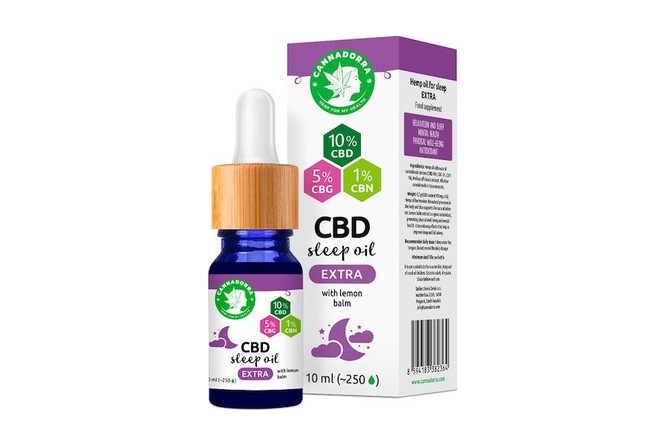
Cannadorra tip: If sleep is your weak spot, deal with that first. A better day often starts the evening before. Some people find it helps to add something to their evening ritual – one of our best-selling products in this area is CBD sleep drops, or a gentler option: Sleep & Relax patches.
2. Stop training your brain to switch all the time
E‑mail. Message. Notification. An open document. Another notification. And back to work – where was I again?
We feel like we're getting more done at once. In reality, though, the brain jumps from one thing to the next and has to "get going" again every time. And that costs energy. When you need to do work that genuinely requires thinking, try a simple routine:
30–50 minutes on one task → a short break → the next block.
Put your phone out of reach and turn off notifications, at least for that time. It works surprisingly well.
Cannadorra tip: For days when you're facing a long meeting, a deadline or an exam, we have Focus patches for concentration. They contain ginkgo, bacopa, magnesium L‑threonate, acetyl‑L‑carnitine, vitamin B3 and green tea extract, and the ingredients are released gradually for up to 12 hours. Stick one on in the morning and forget about it – no capsules in your handbag.
3. Get moving for your brain
Exercise isn't just about muscles, weight and fitness. It's one of the foundations of brain care.
You don't have to start with a marathon. Brisk walking, cycling, swimming, gardening and strength training all count. Rather than one big effort a week, it helps more to get some movement into most days – for example by walking one stop further to the tram. And one trick for the office: when you're just staring at the screen and nothing is coming, spend ten minutes outside instead of having another coffee.
And after exercise, don't forget proper nutrition! Hemp protein will make sure you get enough protein.
4. Your brain needs new challenges, not just crosswords
The brain keeps learning all your life. Learn something that makes you think differently than you do at work. A new language. Dancing. An instrument. A new hiking route. A new computer program. A recipe you've never cooked. What matters is that you can't do it on autopilot.
And when you really want to learn something, don't rely only on re-reading. Close the text and try to say in your own words what it was about. It's precisely active recall that forces the brain to really work with the information.
5. Watch out for long-term stress
Short-term stress can give you a boost. The problem is when your head is running at full speed from morning till night.
If you're thinking about ten other things while you work, it's no wonder there's no attention left for the one in front of you.
A completely ordinary thing helps: stop carrying everything around in your head. Write down tasks, deadlines and the little things you don't want to forget. A calendar or a to-do list isn't proof of a bad memory. It's a way to free up your head for more important things.
It's just as important to give your head a chance to slow down during the day: a few minutes without your phone, a short walk, a few deep breaths between meetings.
Cannadorra tip: When things have been too much for a long time, many of our customers add CBD to their routine. The simplest option is CBD oil 10%: a few drops under the tongue, and you can easily adjust the dose to suit you. If you don't want to bother with a dropper, reach for CBD capsules, which you can take anytime, anywhere. CBD from hemp has no psychoactive effects, so it won't sedate you and you can function normally, even at work.
6. What to eat for your brain?
There's no miracle food that will give you a better memory by tomorrow. What matters much more is how you eat in the long term: plenty of vegetables and fruit, quality fats, protein, wholegrain foods, legumes, nuts and seeds.
Quality fats deserve a special mention. The brain is largely made up of fat, and omega‑3 fatty acids (especially DHA) are one of its important building blocks. Yet most of us don't eat enough of them – fish tends to appear on our plates only on special occasions.
A simple way to get them into your diet:
- BIO hemp oil – cold-pressed oil with a balanced ratio of omega‑3 and omega‑6. Add a spoonful to a salad, to cooked vegetables or to a smoothie. Just don't heat it.
- Hemp oil in fish fats with CBD – a combination of fish oil (EPA and DHA) with BIO hemp oil containing naturally occurring CBD. One spoonful a day with breakfast and your omega‑3 is sorted. And no, it doesn't taste like the cod liver oil you remember from childhood.
- BCP capsules with DHA, D3 and K2 are for those who don't want to deal with a spoonful of oil. They contain DHA from marine algae, vitamins D3 and K2 and beta‑caryophyllene (BCP), a natural substance found in black pepper and cloves. DHA contributes to the maintenance of normal brain function, and vitamin D, which most of us lack in autumn and winter, contributes to the normal function of the immune system.

Cannadorra tip: We recommend taking CBD hemp oil in fish fats every day.
Don't forget to drink, either. Ordinary thirst, hunger or tiredness can seriously knock your concentration during the day.
And coffee? If it agrees with you, you don't have to give it up. But keep an eye on when you drink your last cup. An afternoon espresso that then ruins your sleep costs you more the next day than it gave you that day.
7. Natural support for concentration: what makes sense?
A food supplement won't replace sleep, exercise or a sensible diet. But it can be one part of a well-thought-out daily routine.
At Cannadorra, we created Brain Booster precisely for periods of increased mental strain and demanding working days. It combines seven herbs and adaptogens in a single plant-based capsule – ginkgo biloba, bacopa, ginseng, rhodiola, ashwagandha, tulsi and gotu kola. It's caffeine-free, one capsule in the morning is enough, and it works best when taken regularly – the full effect usually comes after 3–4 weeks.
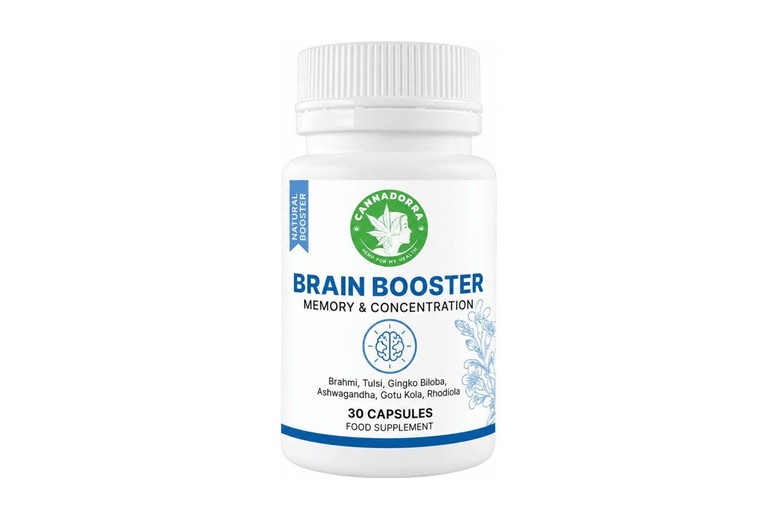
Pictured: Brain Booster capsules to support memory and concentration.
If you prefer a single ingredient, you can reach for Lion's Mane (Hericium) – a medicinal mushroom that has become popular in recent years among people who want to look after their mind in the long term.
How to put it all together sensibly?
- Every day: Brain Booster in the morning + omega‑3 (fish oil with CBD or BCP capsules with DHA).
- For demanding days: add a Focus patch when you need to stay focused for several hours at a stretch.
The same rule applies to supplements as to everything else: don't expect one capsule to fix a routine in which your brain has no chance to rest. A combination of several small changes does the most.
Are you taking blood thinners or other prescription medication? Ginkgo and rhodiola can affect blood clotting, so consult your doctor before taking Brain Booster or using Focus patches.
A simple routine for better concentration after 45
You don't have to change your whole life starting Monday. Try starting like this, for example:
Morning: daylight, a glass of water, breakfast (with a spoonful of oil or an omega‑3 capsule), a few minutes of movement.
Late morning: schedule your hardest task for the time when you have the most energy. Put your phone away, at least for a while. Got a demanding day ahead? Stick on a Focus patch.
During the day: alternate focused work with short breaks and movement.
Evening: gradually reduce stimuli and give your head time to switch from performance mode to rest.
And above all, notice what drains your mental energy. Often it isn't about memory itself – the brain is simply tired, overloaded or short of sleep.
When should you stop blaming forgetfulness on age?
Occasionally forgetting where you put your keys is something different from a significant change that starts to interfere with everyday life.
If your memory problems are getting worse quickly, the people around you are noticing them too, or you're starting to have trouble with everyday activities, finding your way around or communicating, see a doctor.
Neither 40 nor 50 is the moment to accept that "my head isn't what it used to be". On the contrary, middle age is the ideal time to start caring for your brain as naturally as you care for your heart, muscles or joints.