
How CBD Can Help Treat Painful Aphthous Ulcers
Almost everyone has experienced the unpleasant pain caused by mouth ulcers at some point. You can get mouth ulcers – on the tongue, gums, lips, tonsils – in both adults and children. Some people suffer from these white to yellowish sores with red edges chronically, while others only get them occasionally.
In this article, discover essential information and practical advice on why mouth ulcers occur, what helps relieve them, and how to effectively treat painful and unpleasant ulcers not only in the mouth.
- What are mouth ulcers and how can I recognize them?
- What causes mouth ulcers?
- What helps with mouth ulcers?
- How to prevent mouth ulcers?
- Home remedies for mouth ulcers
Article summary:
- Mouth ulcers usually heal on their own within 1–2 weeks, but pain can be relieved with topical products such as CBD spray with colloidal silver or healing gels.
- The development of mouth ulcers is associated with stress, weakened immunity, vitamin deficiencies, or irritation of the oral mucosa. Prevention focused on oral hygiene and a balanced diet can help.
- If ulcers frequently return, are very painful, or heal slowly, it is advisable to consult a doctor, as they may be linked to another medical condition.
What are mouth ulcers and how can I recognize them?
Mouth ulcers, also commonly referred to as canker sores, can appear on the inside of the cheeks, tongue, lips, gums, or even in the throat. Ulcers are usually red with white, yellowish, or grayish centers. They are very uncomfortable and typically cause pain, making it difficult to eat or drink.
Mouth ulcers themselves are not a serious disease, but their occurrence may be connected to other health issues. Therefore, it is important to pay attention if they appear frequently.
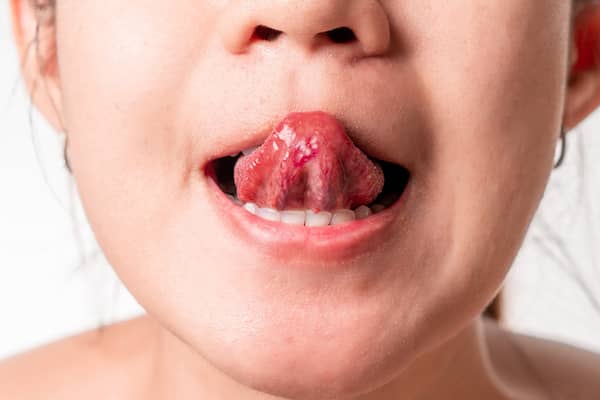
Ulcers on the tongue
The most common type of mouth ulcer appears on the tongue. These are white or yellowish blisters that may range in size from a few millimeters up to one centimeter and cause pain, especially while eating, drinking, brushing teeth, or whenever touched.
Because these ulcers are painful, we recommend avoiding foods that may irritate them:
Ulcers on the lips
Ulcers on the lips are also very common. These are blisters that cause pain when touched by food, during tooth brushing, etc. They can be extremely uncomfortable. They are especially common in people under stress and smokers tend to suffer from them more often.
Here are a few tips for faster healing of lip ulcers:
- Use an over-the-counter local anesthetic
- Maintain proper oral hygiene to keep your mouth as clean as possible, even though brushing may be painful
- Rinse your mouth several times daily with warm salt water
- Avoid hot and spicy foods until the sore heals
Ulcers in the throat
Ulcers in the throat are less common. Hormonal fluctuations also play a role in their development, which is why they often occur in women before menstruation. People with dentures, braces, or chronic smokers are also more susceptible. Mouth ulcers can also appear due to vitamin B, folic acid, or iron deficiency.
What helps with throat ulcers? CBD oral sprays work exceptionally well because their easy application allows them to reach the source of the problem directly in the throat.
Mouth ulcers in children
For children, mouth ulcers can be particularly unpleasant due to their increased sensitivity.
Ulcers in children often occur when they have a weakened immune system (children’s immunity may also be supported by using CBD).
Other causes of mouth ulcers in children include: deficiency of vitamins B and C, zinc, iron, calcium, or folic acid, gluten sensitivity, stress, fatigue, the foaming ingredient sodium lauryl sulfate in some toothpastes, certain foods (citrus fruits, tomatoes, peppers), and more.
If ulcers in children are accompanied by fever, it is advisable to consult a doctor and provide appropriate local treatment. Ensure the child stays hydrated and uses a soft toothbrush that will not further irritate the mouth during brushing.
What causes mouth ulcers?
Although it has not been fully explained why mouth ulcers develop, there is a possibility that they are hereditary. Their development is strongly influenced by stress, vitamin deficiencies (especially vitamin C), and mechanical irritation.
If digestive or intestinal issues occur together with mouth ulcers, it may indicate an autoimmune disease such as Crohn’s disease or celiac disease.
What helps with mouth ulcers?
Mouth ulcers usually disappear within 7–10 days. To relieve the unpleasant pain they cause, we recommend using solutions with anesthetic effects.
From our hemp product range, we recommend a CBD spray that contains CBD (which helps relieve pain) as well as colloidal silver with antibacterial properties, making it especially suitable for ulcers and cold sores. After applying the CBD spray, mild numbing occurs and the pain gradually subsides. The application can be repeated several times daily.
The advantage of CBD spray is its easy application, allowing it to be used on ulcers both in the mouth and in the throat.
If you prefer applying an ointment instead of a spray, try CBD coconut oil. It can be applied directly to the ulcer using a cotton swab and works very effectively.
Of course, especially with recurring ulcers, we also recommend regular use of CBD oil, which helps relieve pain and significantly strengthens the immune system.
From our experience, regular application of the spray often helps ulcers disappear in less than 7 days.
Prevention
To help prevent mouth ulcers, we recommend maintaining a varied and balanced diet, especially ensuring sufficient intake of vitamins C, B6, B12, and iron – hemp protein naturally contains vitamin C, B6, and iron.
It is also advisable to keep the oral cavity clean and avoid sharing drinks with others.
It is equally important to choose suitable oral care products that are non-irritating while effectively keeping the mouth clean – for example, a hemp toothpaste.
Home remedies: What helps with mouth ulcers
Traditional remedies recommend using herbs for mouth ulcers – soothing the affected area with herbal gargles. The most commonly used herbs are chamomile (try drinking or rinsing your mouth with hemp tea with chamomile), sage, or agrimony.
Propolis, which has disinfecting properties, or even ordinary onion can also help soothe a painful oral mucosa.
Article author: Lucie Garabas