
How to make hemp ointment - recipe
Author of the article: Lucie Garabas
How to make hemp ointment? We will be happy to guide you! Make your own original hemp ointment with maximum effect. It will certainly be original, because you will put your own energy into it. Even the preparation of hemp ointment itself is a healing process. Making a remedy yourself is one of the most restorative and beautiful things you can do for your body or for your loved ones.
The process is, of course, more time-consuming than simply going to a shop and buying an ointment. But that is exactly why the ointment can be even more effective. The journey is the destination. It is important to think positively while making the ointment and to focus on the fact that it is healing, either for us or for the person we are preparing it for. Good luck! Here is a simple guide.
What kind of hemp ointment do you want to make?
Before you start making hemp ointment, it is useful to clarify what effects you want the hemp ointment to have. In other words, what you ultimately want to use it for. According to studies and research, the following effects of hemp ointments have been observed: for skin problems, inflammation, bruises, mobility issues and stiffness of joints and back, chronic neck and back pain, and acute muscle and joint problems.
So, generally speaking, you need to decide whether you are making a hemp ointment for the skin or for muscles and joints, as each requires a slightly different approach. While an ointment for the skin should have more of a cooling effect, an ointment for muscles and joints should warm the area. The herbs we add to the ointments will also differ.
Jump to the recipe that suits you:
- Traditional hemp ointment recipe
The original, proven method for making homemade hemp ointment. - New hemp ointment recipe
A newer shea butter formulation with a simpler preparation process.
❓ Do you have questions about making hemp ointment?
Our experts will be happy to advise you. Send us your question and get an answer within 24 hours.
Hemp ointment recipe
In our recipe we use shea butter as the base, which we heat together with hemp herb and marigold flowers. After extraction and filtering, hemp oil, beeswax and vitamin E are added to the base.
For making hemp ointment for the skin we also use marigold flowers (Calendula officinalis), which is known for its traditional use in skin care. Studies confirm the effects of Calendula officinalis on accelerated wound healing (official 2019 study), reduction of inflammatory pain (study in which the application of topical products with Calendula officinalis led to pain reduction), and antioxidant effects (link to the study).
Ingredients for making hemp ointment
- 750 g shea butter
- 100 g hemp herb
- 50 g marigold flowers
- 250 ml hemp oil
- 100 g beeswax
- 5 ml vitamin E (tocopherol)
You will find the base for homemade hemp ointment with us:
According to the recipe you will need, among other things, hemp oil and hemp herb. You can order these two main hemp ingredients right here:
Tools for making homemade hemp ointment
- a pot
- a kitchen thermometer
- a hand blender
- fine cloth or a fabric handkerchief
- a fine stainless steel sieve
- jars or containers with lids
Making hemp ointment at home step by step
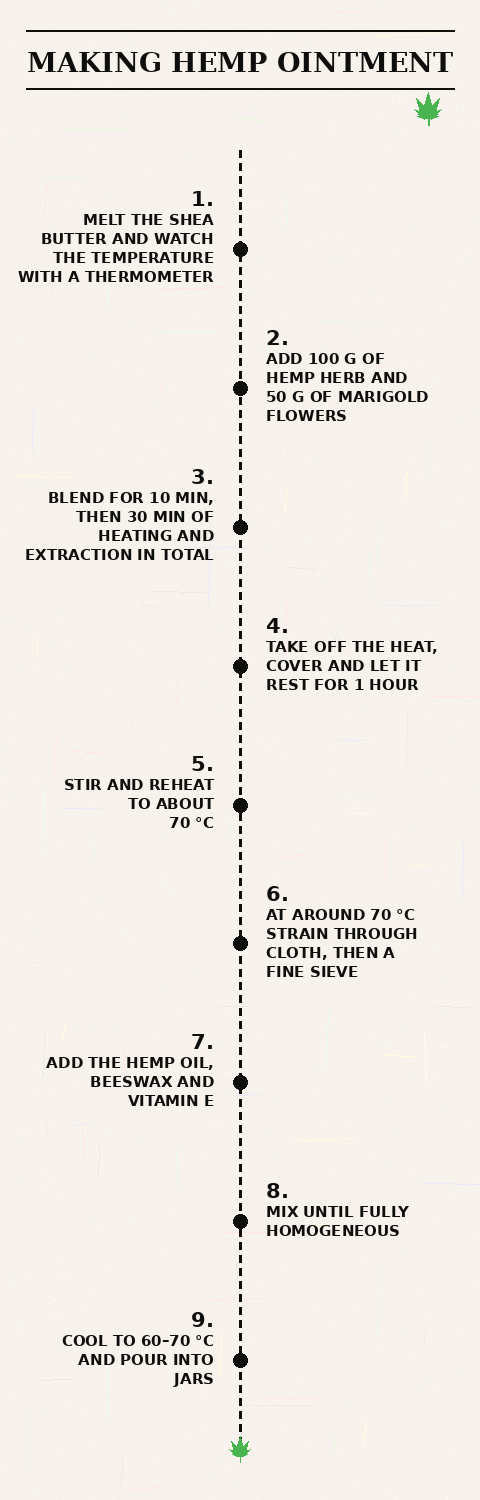
- Melt the shea butter. Heat the shea butter gradually and check the temperature with a thermometer while heating.
- Add the herbs. Add 100 g of hemp herb and 50 g of marigold to the melted shea butter.
- Blend the mixture and let the extraction take place. After adding the herbs, blend the mixture for approximately 10 minutes. From the moment the herbs go in, count 30 minutes of heating and extraction in total, and maintain the set preparation temperature throughout.
- Let the mixture rest. After 30 minutes of heating, take the mixture off the heat, cover it with a lid and let it rest for 1 hour.
- Reheat the mixture. After an hour, stir the mixture and, if needed, reheat it to approximately 70 °C. Shea butter thickens fairly quickly as it cools, and a colder mixture is then harder to press and filter.
- Strain and filter the mixture. At around 70 °C, strain the mixture through cloth or a fabric handkerchief. Squeeze or press the plant material thoroughly so that as little fat as possible remains in it. For a finer final ointment you can then filter the mixture through a fine stainless steel sieve as well. Work quickly enough at this step, because as the temperature drops the mixture thickens and passes through the fine sieve less easily.
- Add the remaining ingredients. Add the hemp oil and beeswax to the filtered shea base, followed by the vitamin E. Watch the temperature when adding the beeswax. The wax must dissolve completely in the mixture. If it starts to set or curdle in a base that is too cold, reheat the mixture above 70 °C and stir until it is completely homogeneous.
- Mix the mixture thoroughly. The shea butter, hemp oil, wax and the other components must combine evenly.
- Let the ointment cool slightly and fill the jars. Let the finished homogeneous mixture cool to approximately 60–70 °C and, once it has a suitable fluidity, pour it into the prepared jars.
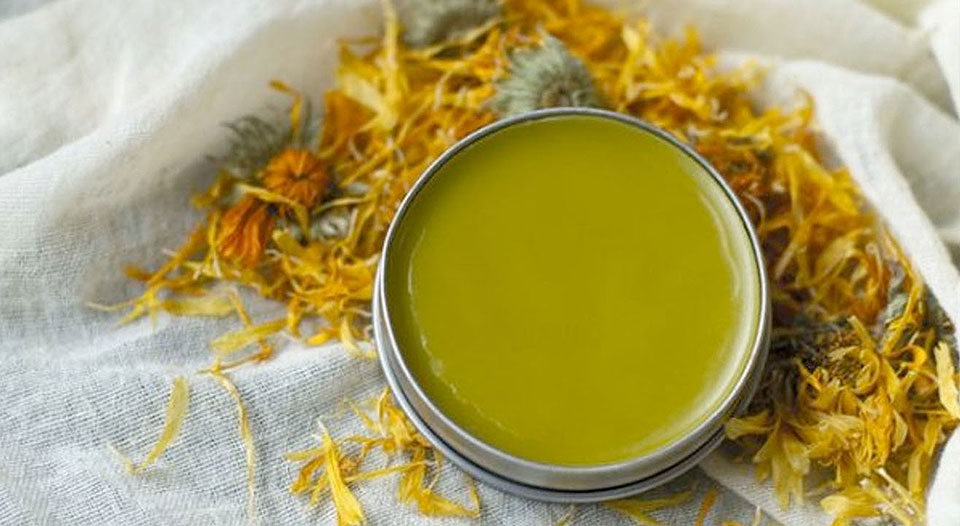
New recipe for homemade hemp ointment
If you would like to try a different way of making it, we have also prepared a new recipe for homemade hemp ointment for you, which works with shea butter, hemp herb, hemp oil, beeswax and vitamin E. For this method we have put together a practical kit that contains all the ingredients and a step-by-step procedure.
Ingredients for the new hemp ointment recipe
- 750 g shea butter
- 100 g hemp herb
- 50 g marigold flowers for making homemade hemp ointment for the skin
- 50 g crushed comfrey root (Symphytum officinale) for making homemade hemp ointment for muscles and joints – we use it instead of marigold
- 250 ml hemp oil
- 100 g beeswax
- 5 ml vitamin E (tocopherol)
Kit for making homemade hemp ointment
We have prepared a kit for you containing the ingredients needed to make homemade hemp ointment:
The hemp ointment procedure – new formulation
- Melt the shea butter. Heat the shea butter gradually and check the temperature with a thermometer while heating.
- Add the herbs. Add 100 g of hemp herb to the melted shea butter and, depending on the type of ointment you are making, either 50 g of marigold for a skin ointment or 50 g of crushed comfrey root for an ointment for muscles and joints.
- Blend the mixture. After adding the herbs, blend the mixture for approximately 10 minutes. From the moment the herbs go in, count 30 minutes of heating in total, and maintain the set preparation temperature throughout.
- Let the mixture rest. After 30 minutes of heating, take the mixture off the heat, cover it with a lid and let it rest for 1 hour.
- Reheat the mixture. After an hour, stir the mixture and, if needed, reheat it to approximately 70 °C. Shea butter thickens fairly quickly as it cools, and a colder mixture is then harder to press and filter.
- Strain and filter the mixture. At around 70 °C, strain the mixture through cloth or a fabric handkerchief. Squeeze or press the plant material thoroughly so that as little fat as possible remains in it. For a finer final ointment you can then filter the mixture through a fine stainless steel sieve as well. Work quickly enough at this step, because as the temperature drops the mixture thickens and passes through the fine sieve less easily.
- Add the remaining ingredients. Add the hemp oil and beeswax to the filtered shea base, followed by the vitamin E. Watch the temperature when adding the beeswax. The wax must dissolve completely in the mixture. If it starts to set or curdle in a base that is too cold, reheat the mixture above 70 °C and stir until it is completely homogeneous.
- Mix the mixture thoroughly. The shea butter, hemp oil, wax and the other components must combine evenly.
- Let the ointment cool slightly and fill the jars. Let the finished homogeneous mixture cool to approximately 60–70 °C and, once it has a suitable fluidity, pour it into the prepared jars.
🎯 Does making the ointment seem complicated?
Make it easier and order a ready-made hemp ointment!
Storing homemade hemp ointment
The finished hemp ointment is best stored in a cool, dark place. The ointment should not contain too many herbal particles, as they could worsen its final texture.
Is making homemade hemp ointment too difficult for you?
If you feel that making homemade hemp ointment is difficult, whether because of the preparation itself or the time it takes, we have an effective solution for you! Try the ointments you will find in our range. They are made according to the traditional recipes of our grandmothers, have answers to the most common questions and come at a great price. After opening a hemp ointment from Cannadorra, we are sure you will feel as if you had made it yourself.
Try proven quality on your own skin:
FAQ – How to make homemade hemp ointment?
Yes, but only if the plant type is officially approved for agricultural use in your country and meets the current legal limit for psychoactive substances. National rules differ, so always check the current requirements in your location before use.
This preparation process is set up for the use of shea butter. If you use a different fat, the processing temperature, the texture and the course of filtration may all change.
The shelf life of a homemade ointment depends on the quality of the ingredients used, the hygiene during preparation and the way it is stored. Keep the ointment in a well-sealed container in a cool, dark place.
Yes, it can be. However, it is always recommended to test it first on a small area of skin and consult a specialist, especially for very young users under 3 years of age or sensitive pets.
Keep the finished ointment in a well-sealed container, ideally in a cool, dark place and away from direct sunlight.